


To meet the needs of one of their most productive contracts, IET’s engineers partnered with Shell, one of the world’s largest oil & gas companies, and successfully applied their proprietary technologies to detect precursors of wear and damage to rotating equipment for Shell’s installation of Centrilift electric submersible pumps (ESPs), compressors, and turbines.
To meet the needs of one of their most productive contracts, IET’s engineers partnered with Shell, one of the world’s largest oil & gas companies, and successfully applied their proprietary technologies to detect precursors of wear and damage to rotating equipment for Shell’s installation of Centrilift electric submersible pumps (ESPs), compressors, and turbines.
“Algorithms allowed us to process aliased data and extract hidden signals.”
— Jim Tedesco, CEO of IET
The collaboration began when IET was brought in to assist Qualex Consulting Services, who faced challenges in predicting ESP motor failures. By combining statistical analysis with a physics-based approach, IET developed tools that achieved optimal accuracy in forecasting failures.
“Statistical analysis alone can’t solve everything. Without understanding the physical model of how something works, it’s a gamble.”
— Dr. Terry Riemer, President of IET
After careful analysis, IET’s engineers formed affiliate company Sygnology for the purposes of servicing this project and realized that Qualex’s statistical approach had not considered the physical principle model based on electrical engineering concepts of Shell’s ESP configuration
IET applied its proprietary technologies to investigate the ESP historical data and revealed compelling evidence of motor damage incidents by identifying signature anomalies in the processed output, precursors of wear and damage occurring in the ESPs that were previously overlooked by traditional statistical monitoring methods.
“If there is a periodic component, our technology can detect a signal even though you can’t see it with the human eye,” Mr. Tedesco said. “It was important for us to build a physical model in order to better understand these complex systems.”
Following a series of contract negotiations, IET set out to advance the analyses and incorporate it into Shell’s Exception-Based Surveillance (EBS) event detection system. This effort began with a review of historical data and eventually included the development of event detection templates to be deployed in an active environment with further research concentrating on algorithm development.
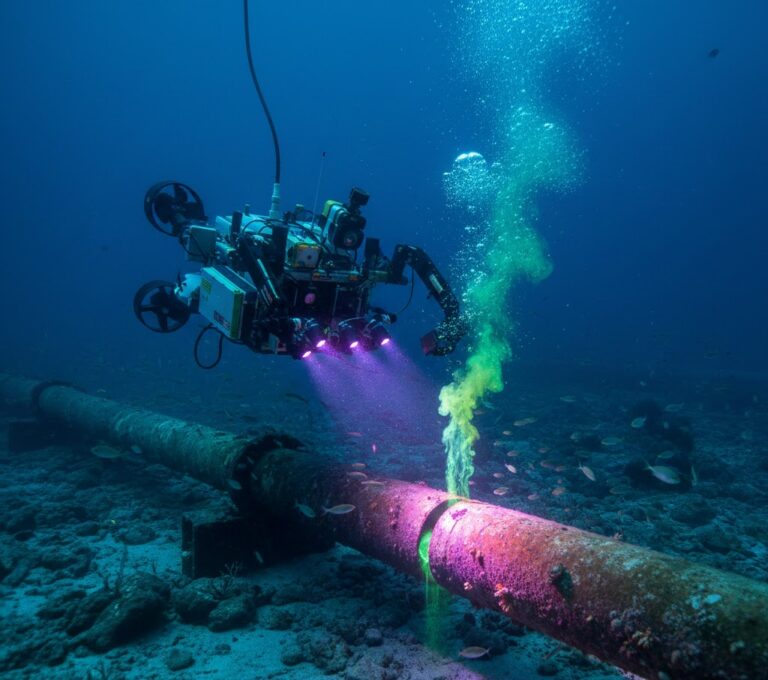
In addition to identifying signs of rotating equipment damage, IET’s engineers reviewed historical data to detect the presence of leaks. IET’s technology was able to identify acoustic signature anomalies that coincided with confirmed leaks through failure reports and inspection results of Shell’s expansive piping systems.
image copyright Baker Hughes
The historical data analysis performed by IET, coupled with associated verified failure reports, including remotely operated vehicle (ROV) inspection results, coincided with acoustic signatures consistent with small leaks to create a repertoire of confirmed leaks detected by this method.
The partnership delivered outstanding results, saving Shell $16.85 million. IET’s technology didn’t just predict equipment failures—it gave Shell the time and information needed to take action, prevent major downtime, and protect their operations.
Key Achievements:
IET’s technology did more than prevent failures—it revealed key design flaws in Shell’s ESPs, providing insights that drove valuable improvements and long-term savings.
“Our technology showed flaws in the design of the ESPs and allowed Shell and Centrilift to redesign the pumps to eliminate the problems,” said Mr. Tedesco. “This generated significant value and saved the company a lot of money.”
By turning data into action, IET helped Shell quickly resolve urgent issues and make their equipment more reliable for the long term. This partnership is proof that smart engineering and teamwork can transform operations and deliver real financial gains.
Expanded application of this method is expected to yield less than one false positive per year, a significant improvement over the current, previous, and alternatively proposed systems based on time domain data.
As a result of this work and the technology’s potential, Shell partnered with IET’s engineers to monitor their existing ESPs using IET’s proprietary technology. Ultimately, IET developed waveform parameter analysis tools and expanded equipment monitoring services to include compressors and turbines.
During the contract period, IET’s partnership with Shell led to the successful prediction of asset failures. Official Shell Value Capture Reports indicate $14.35 million in total savings related to ESP surveillance as a direct result of the research and development efforts.
In summary, IET’s technology demonstrated the presence of signatures which indicated damage to thrust bearings, resulting in the change of operating conditions to extend the life of pumps long enough to schedule and deploy a drilling rig for repairs, avoiding extended deferred production valued at $8.1 million.
The process then detected multiple imminent bearing failures, which allowed Shell to re-schedule existing drilling projects around the expected failure and plan for pump replacement without waiting for an existing drilling rig to become available. These alerts avoided extended deferral valued at $4 million and $2.25 million dollars, respectively.
“Our technology showed flaws in the design of the ESPs and allowed Shell and Centrilift to redesign the pumps to eliminate the problems,” Mr. Tedesco said. “This generated significant value and saved the company a lot of money.”
In addition to those cost savings, IET’s technology identified active damage to the overboard valve at Shell’s Mars offshore drilling and production oil platform operating in the Gulf of Mexico. Upon analysis, it remained unknown whether existing damage could be halted, but the Shell Bridge and IET’s engineers recommended Mars take any available action via process adjustments to eradicate this signature, strongly suggesting the valve discharge pressures once again be raised over 220 PSI.
These findings were readily accepted and corroborated by observations of the Mars team. Probable action reports assigned savings of $2.5 million over the life of the Mars field as a result of the information and advice provided by IET’s engineers, thus resulting in a total of $16.85 million in cost savings for the company.
“We can customize the technique to extract the right information to solve problems before they get worse,” Dr. Riemer said.
In the end, IET’s engineers developed technology that helped solve complex problems and saved millions of dollars, and this was the successful result of their partnership with Shell.
Explore our other projects with Shell: